Trip Log - Brent / Maple Lake / Catfish Lake Loop
1975 August 11 to 21
In 1975 August, Bob and Diana undertook a 10 day canoe trip starting and ending at Brent on Cedar Lake in Algonquin Park. We travelled through Little Cedar, Aura Lee, Laurel, Cauchon, and Little Cauchon Lakes to Mink Lake. From there we doubled back through Whitebirch and Waterclear Lakes, then went via Club, Mouse and Big Thunder Lakes to Erables Lake. We moved on to Maple Lake for a day, then returned to Erables Lake and travelled through Skuce, Little Nadine, Little Osler, Osler and Nadine Lakes to the Nipissing River. The original plan was to descend the Nipissing River all the way to Cedar Lake. However, we were ahead of schedule and feeling strong, so went only part way down the Nipissing River, portaged over to Luckless Lake, then went through Lynx Lake to Catfish Lake. From there we followed the Petawawa River down through Narrowbag Lake and back to Brent.
Material from our log, recorded at the time, is reproduced below. Many entries in the original log are records of arrival times at various points or times spent on portages. Some of this material has been edited out of the trip log text below, but is summarized at the end.
1975 August 11 — Brent to Little Cauchon Lake
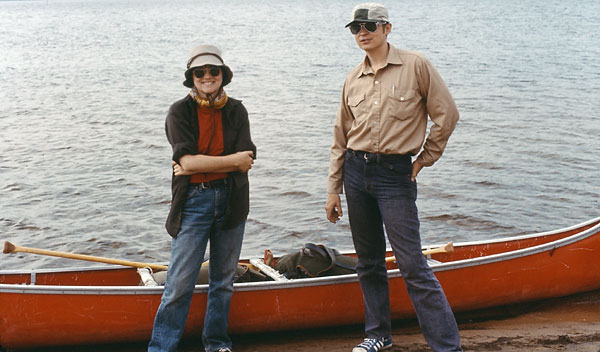
On the beach at Brent, all packed up and and ready to head out in our 16', St. Maurice canoe, borrowed from Diana's parents. (Not sure what it weighed but chopped glass is somewhat heavier than carbon fiber.)
Bob sure didn't have a lot of meat on him in those days (but he's made up for it in the interim!) And where did he get those sunglasses?
- - Warm - many large cumulus clouds - wind from West
- - We left Brent 11:00, had lunch end of Cedar Lake (12:50 to 1:15) and arrived at the last campsite on Little Cauchon Lake at 5:20 (all the other sites had been taken)
- - Celestine soup, tuna goo for supper

Diana preparing supper at Little Cauchon Lake. And yes, that is a can of tuna that she is opening; the can and bottle ban was three years in the future. Also visible in the photo are two Woods Canoe packs (canvas with leather straps, including tump line), homemade canvas food bag, homemade canvas kitchen roll, canvas water bucket, park garbage bag, food rope with billet of firewood (for throwing) still attached, two of our trusty Bulldog pots, and a lot of other stuff spread around to make things feel like home.
1975 August 12 — Little Cauchon Lake to Mink Lake
- - up at 6:30 - clear day starting calm - lots of loons
- - eggs & pork sausage for breakfast
- - We left campsite at about 9:00 and stopped for snack break almost to the end of Cauchon Lake at 10:25, having taken a ~15 min photography break previously
- - We couldn't find the portage into Club Lake and wasted at least an hour looking. We also made an abortive attempt at bushwhacking on what appeared to be an obsolete portage trail. The trail was too difficult to follow and very rough
- - We stopped at campsite on point half way up Mink Lake at 1:30 PM and decided to stay
- - dropped pocket watch in lake
- - into bed by 9:00 PM
- - Jerky curry for supper. (note: next time bring more coffee).

Morning on Cauchon Lake.
1975 August 13 — Mink Lake to Mouse Lake via Whitebirch, Waterclear and Club Lakes
- - up at 6:00 - southeast wind - mostly overcast - red sky in east - no sun visible
- - Red River cereal & nuts for breakfast - need more sugar
- - heavy overcast in west - couple of cracks of thunder - a little rain
- - on the water by 8:30
- - We reached White Birch Lake at about 10:15 and stopped for a break. The sky was lightly overcast with a strong wind out of the south.
- - We stopped for lunch at an unmarked campsite on the south side of Waterclear near narrows. We restarted at 12:30. There is an unmarked [in 1975] portage of about 350 yds at the end of Waterclear into Club Lake. The take out is a real S.O.B.
- - There is what appears to be an abandoned logging camp on Club Lake, although perhaps a little fancy for a logging camp.
- - We found the other end of the portage we couldn't find yesterday. We walked over it and back which took about 25 min - length 1350 paces. It comes out up Mink Creek - farther up than we waded yesterday. With the prevailing water levels canoe would have had to be walked up.
- - Club Lake narrows were quite shallow
- - We had to wade canoe up creek in parts to reach portage into Mouse Lake
- - It is now 5:25. We are camped (but not yet set up) on an unmarked campsite on Mouse Lake. We have already had our swim. The wind is now very strong from the west southwest (white caps on the lake) - sunny with cumulus clouds
- - In bed at 8:45
- - Vegetable soup, chicken stew for supper

Club Lake.
According to Donald Lloyd in his book "Canoeing Algonquin Park", the "logging camp" we mention in our log was a lumber mill operated by Richie Bros of Ottawa. There was also a spur railway line that led to the mill. The mill ceased operation and the site was abandoned before WW II. After the war it was run briefly as a tourist operation.
1975 August 14 — Mouse Lake to Erables Lake
- - strong winds all night
- - up at 6:30 - wind strong out of west - clear sky
- - mushroom omelette for breakfast
- - away by 9:15
- - 1860 yd. portage to Mink Creek, 9:50 to 11:35, mostly uphill, trail rough in spots, wet at both ends
- - 250 yd. portage Mink Creek to Thunder Lake, 12:05 - 12:25, rough - relatively new
- - We stopped for lunch on prominent point on Thunder Lake at 12:40 It has previously been used as a campsite; looks OK for 1 tent
- - wind still strong out of west - temp 69°F
- - 1800 yd portage to Erables Lake, 1:45 - 3:10, trail rough and fairly new
- - Camped on island, lower end of Erables Lake
- - a group of 5 Americans were camped at other end of island. Bill and Evelyn and family from Canton Ohio
- - went to bed about 10:00 - wind essentially died

Mink Creek, on the way to Big Thunder Lake from Mouse Lake.

Campsite on Erables Lake. Taymor "Hunter" 3-person nylon wall-tent with modified rain fly. Woods Nessmuck pack by door of tent. Full size axe at left of photo. And cooking on a fire; we didn't have a stove.
1975 August 15 — Erables Lake to Maple Lake
- - Bill and Evelyn visited early (before 7:30)
- - We left at 10:00 AM and visited them. We had lunch with them and finally left at 1:30 or maybe 2:00
- - Camped on island, north side of Maple Lake.
- - into tent for night at 8:50
- - Weather unsettled but we expect rain
- - Jerky stroganof and Vermicelli soup for supper

Evening on Maple Lake.
1975 August 16 — Maple Lake to Skuce Lake
- - up at 6:30 - sky clear - light breeze from east - clouds appeared later from south - breeze rising.
- - left about 9:15
- - met Bill and Evelyn at 90 yd. portage & exchanged addresses
- - We arrived campsite on Skuce Lake at 1:50
- - The day had been warm & sunny, large cumulus clouds, wind now mainly from west, not too strong
- - lazy afternoon
- - jerky macaroni, soup with macaroni shells for supper
- - There are lots of birds here - chickadees, warblers, whiskeyjacks, woodpeckers, loons, mergansers, hummingbirds (very close) & others in trees & on ground; also loons & mergansers; tame-ish but skittish chipmunk; pine borers [sawyer beetle] making lots of noise.
- - in tent at 8:15 - rest of day was warm - breezes from various directions - now clouds streaming out of west
- - quiet night except for loons

Making our way up Skuce Creek. Diana never noticed the leech on the back of her leg.

Our campsite on Skuce Lake, with all the comforts of home. Except the big tree behind the tent was full of pine sawyer beetles, and all night long we could hear them gnawing out the insides of that tree. Just how much wood was left inside the bark? "Not much!" you imagine in the middle of the night. Two years later we passed by this campsite again, and the tree was still standing. (But we'd be willing to bet it's gone now.)
1975 August 17 — Skuce Lake to Nadine Lake
- - up at 6:15 - light airs, clouds intermittent -little sunshine - clouding more heavily from west - wind rising from east
- - on water by 9:00 - started to rain as we left
- - We finished portage into Little Nadine by 9:30 and stalled around waiting for wind to let up
- - Started portage to Little Osler at 10:00. The portage is a real brute in this direction. i.e. 250' climb. Open deciduous forest (maples and beeches) at top. Finished portage at 11:25
- - Stopped for lunch on Little Osler at 11:45 (It has stopped raining)
- - 1900 yds. to Nadine about1:00 - 3:00. The trail went up & down a lot, but not as bad as we expected from Bill and Evelyn's description
- - clouds clearing away & bits of sun - wind out of west
- - camped at old site, south side of Nadine, stopping about 3:30. We had checked out newer site on other side behind islands but it was gloomy, and also it had had a ground fire & was marked "no fires" on the sign.
- - Where we stopped is very spacious, well set up, faces north. It is open but sheltered from wind.
- - some fantastic big trees around (birch, white pine)
- - sky continued to clear - wind west - sunset red, wind rising & falling
- - canned ham for supper (very good) & yellow pea soup
- - In tent for the night at 8:40

The bush through here is mostly beautiful hardwood, but some of the hills are steep.

Nadine Lake campsite.
1975 August 18 — Nadine Lake to Rolling Dam on Nipissing River
- - windy intermittently through night
- - up at 6:00 - clear sky, 47°F - distinct north wind
- - on water at 8:40
- - 1540 yd portage to Nipissing, 8:50-9:45, good trail (old road)
- - paddled through marsh & stopped for lunch at 1:00 at end of 400 yd portage.
- - wind north, large cumulus clouds
- - 2 portages 200 yds each
- - camped at bottom of 2nd one where we had camped in May, [Rolling Dam], at 2:30
- - day cool, more clouds than sun
- - potato soup, jerky stew for supper, made bannock
- - wind died at sunset
- - in tent for the night at 8:40

Nipissing River at the Nadine Lake portage.

Nipissing River Marsh. Once you're on the river, the view is more limited
1975 August 19 — Nipissing River to Catfish Lake.
- - calm night, good sleep
- - up at 6:30 - temp 40°F- sky mainly clear - mist on water - wind from northwest
- - on water at 8:35
- - We reached portage to Luckless Lake at 8:55 - finished at 11:10. 3100 yd seems to be accurate length, trail mainly along roads & uphill poor footing in gravel (4100 paces).
- - crossed Luckless Lake - very pretty.
- - took 650 yd. portage into Lynx Lake, 11:35-12:05, mainly along very old roads.
- - We had lunch on Lynx Lake and watched an otter eating a fish.
- - We went out through narrow & shallow channel into Catfish Lake. It looks like other portage from Luckless Lake has been changed due to shallowness of bay
- - We stopped at an unmarked (on map) campsite not far from 90 yd. into Narrowbag at about 2:30
- - chicken curry, onion soup for supper
- - winds northwest by west all day - large cumulus clouds - coolish (had a swim anyway, felt great) - wind calmed at sunset - "evening cloud of northland" again
- - into tent for the night at 8:35.

Diana portaging along the Nipissing River
By this stage of the trip, we were feeling stronger and the packs were lighter. One of Diana's favourite memories of this trip occurred at the start of the 3000 yd portage over to Luckless Lake. (We had decided to add to the trip by portaging over to the Petawawa River system.) She had already taken one pack several hundred yards down the trail and returned for the second. She was aware of a couple of young guys, camped at the start of the portage, who were watching (but pretending they weren't). She grabbed the impressively bulky Duluth pack by its ears, tossed it onto her bent knee, swung it around onto her back, placed the tump line over her forehead and set off down the trail in one smooth motion. She overheard one of the guys saying to his friend: "Wow, did you see that?"
Strength is important, but technique is paramount.

Bob portaging over to Luckless Lake. This was not a pleasant portage. Not only was the footing poor, it was out in the open, and therefore oppressively hot, plus you could see the trail winding off into the distance. There was no deluding yourself that the lake was just around the next corner.

"Evening Cloud of the Northland" on Catfish Lake.
1975 August 20 — Catfish Lake to Cedar Lake
- - Calm night, full moon
- - up at 6:15 - clear & calm - 50°F
- - on water at 8:30
- - into Narrowbag by 9:15 (saw bear with 2 cubs at portage)
- - wind light - northwest by west
- - 3100 yd. portage to Petawawa, 9:55 - 10:30, (took shortcut, 3300 paces). (saw a weasel on the trail)
- - ate lunch at 12:15 at top of 280 yd portage
- - took pictures of waterfalls
- - into Cedar Lake by 2:30
- - camped up lake from mouth of Nipissing at 4:40
- - Jerky curry, pea with smoked ham soup for supper
- - beautiful evening, calm, full moon
- - in bed at 8:20

Diana looking for a shortcut at the beginning of the long portage down the Petawawa from the bottom of Narrowbag Lake.
In years previous there was a dam across the Petawawa River near here. The portage started on the left hand shore, crossed the dam and continued downstream. When the dam rotted away, the start of the portage moved to the right hand shore. But because of shoreline obstructions, it started well to the right (east) of the river and added another 500 yds. to the portage. At this water level, however, we were able to cheat and bypass that first section along the shore. Sometime in the late '70s, the portage was rerouted to its modern configuration. A short portage, starting several hundred meters west (left) and out of sight of this location, goes from Narrowbag Lake to the Petawawa River. The long portage starts just across the river and mostly follows the old route down.

Falls and timber slide on Petawawa River.

The grave of A. Corbeil, June 1, 1888, at the top of the waterfalls on the Petawawa River. (IHS is an abbreviation for the name of Jesus Christ.)

The falls on the Petawawa River, just above Cedar Lake, at low summer levels.
1975 August 21 — Cedar Lake to Brent
- - calm night, spectacular sunrise
- - up at 7:20 - 50°F clouded over, intermittent rain
- - ate breakfast & lunch at campsite
- - explored a bit of shore, headed to Brent, arrived at 1:30
- - wind started east, shifted to southeast, southwest strongly at about 1:00, west by 2:30 (our pickup time)
Since this was our first significant "travelling trip", we recorded a lot of information with respect to start and stop times, distance traveled, etc. The intent was to get a better handle on our expected speed for planning purposes. A summary of our traveling times follows:
| Day | Time | Paddling Dist. (mi) | Portaging Dist. (yd) |
| 1 | 5 hr 20 min | 10.9 | 500 |
| 2 | 3 hr 30 min | 5.5 | 480 |
| 3 | 7 hr 00 min | 6.9 | 3000 |
| 4 | 5 hr 15 min | 2.8 | 3910 |
| 5 | 1 hr 30 min | 3.0 | 90 |
| 6 | 4 hr 05 min | 4.6 | 1700 |
| 7 | 5 hr 30 min | 2.4 | 4780 |
| 8 | 4 hr 50 min | 8.8 | 2340 |
| 9 | 4 hr 55 min | 4.8 | 3750 |
| 10 | 5 hr 00 min | 5.0 | 3850 |
| 11 | 1 hr 15 min | 4.0 | 0 |
| Total | 48 hr 10 min | 58.7 | 24,400 |
The times have been approximately corrected to account for lunch, breaks, etc. (Canada went metric sometime in the mid '70s. In metric, the total paddling distance was about 94 km and total portaging distance was about 22 km.)
These data indicate that we paddled at about 2.25 miles per hour (3.6 km/hr) and portaged at about 1150 yards per hour (1 km/hr). (For portaging, we have three loads — the canoe plus a small pack and two Duluth packs — that we "leap frog" across.)
On the basis of further trips, we settled on the following for planning purposes: On a traveling day, we travel for 6 hours at a paddling rate of 3 km/hr and a portaging rate of 1 km/hr. This is pretty conservative compared to advice we currently see posted on the net, but these guidelines have served us well. Your mileage may vary.
Sources
Donald L. Lloyd (2000); Canoeing Algonquin Park, Published by D.L. Lloyd. Distributed by Hushion House Publishing Ltd. Toronto.