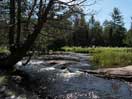
Exploring Eastern Algonquin Park
from the Achray Road
I was recently asked about opportunities for short trips and expeditions in Eastern Algonquin Park accessible via the Sand lake Gate. On this page, I am expanding on my reply to that query and providing links to pictures and information elsewhere on this site.
Heading into Eastern Algonquin Park -- approaching the Sand lake Gate on the Achray Road.
There are many good day trips accessible via the Achray Road and the Sand Lake Gate. Some include:
- The Barron River and Canyon
- Opalescent Lake / High Falls Lake Loop from Brigham Lake Access
- High Falls
- St. Andrews Lake
- Carcajou Bay / Carcajou Creek / Spectacle Lakes
- Grand Lake
- McManus Lake to Whitson Lake
- Eustache Lake
- Lake Travers
- Sec Lake
- Wenda Lake
- Berm Lake and Eastern Pines Hiking Trail
The Barron River and Canyon
The Barron Canyon is one of the scenic beauties of eastern Algonquin Park. It is easily explorable as a day trip, starting from Squirrel Rapids, paddling up the Barron River and through the canyon to the foot of the Brigham Chute Portage and return. It only involves a single portage (but done twice) around Cache Rapids. A nice trip but potentially busy. Probably best done on a weekday, avoiding July and August.
Mid Fall in the Barron Canyon
Last Monday (2007 October 22), Bob and Diana went on a day trip by canoe through the Barron Canyon in Algonquin Park. It was a repeat of the trip we did six months ago but this time the objective was solely to take advantage of a beautiful fall day. Shortly after 9:00 a.m., we started at the launch point just above Squirrel Rapids and traveled upstream, portaging around Cache Rapids and paddling through the canyon to the foot of the Brigham Chute portage. After backtracking a short distance and eating lunch in the canyon, we retraced our morning route to arrive back at the start point a bit after 3:00 p.m.
Early Spring in the Barron Canyon
Last Wednesday (2007 April 25), Bob and Diana undertook a day trip through the Barron Canyon by canoe. Although our objective was to photograph the small waterfalls that plunge down the canyon walls during the spring runoff, no excuse is really needed for a trip into the Park. We started at the launch point just above Squirrel Rapids at about 9:15 a.m. and traveled upstream, portaging around Cache Rapids, paddling through the canyon, and visiting Brigham Chute. After eating lunch in the canyon, we returned by the same route, arriving back at the start point around 4:15 p.m.
Cedar Tree
Some trees live a hard life. This cedar tree is growing out of the bedrock along the Barron River in Algonquin Park. I was intrigued by the harsh environment and that this tree continues to survive in it.
I was also attracted to this scene by the contrast between the green of the cedar foliage and the bright orange of the Xanthoria lichen coating the rock face. Both are indicators of the presence of lime in the rock. This gives rise to some locally unique plants -- most notably, encrusted saxifrage -- farther upriver in the Barron Canyon.
(photographed: 2005 May 18)
Cache Rapids
... on the Barron River in Algonquin park
Another picture from our recent trip: Early Spring in the Barron Canyon.
(photo by Diana: 2007 April 25)
Canyon
... the lower end of the Barron Canyon.
For more of our pictures from the Barron Canyon, see Mid Fall in the Barron Canyon.
(photo by Diana: 2007 October 22)
Reflections
... and cliff face in the Barron Canyon in Algonquin Park.
(photo by Bob: 2007 October 22)
Waterfall
A small stream drops into the Barron Canyon in Algonquin Park.
(photographed: 2005 May 18)
The rim of the Barron Canyon is accessible via a walking trail off the Achray Road
Rim Shot
Shot along the rim of the Barron Canyon in Algonquin Park. It's too bad that the ground is so beaten to death along this trail.
(photographed: 2006 April 27)
Opalescent Lake / High Falls Lake Loop from Brigham Lake Access
Another good day trip, but one that involves a reasonable amount of portaging is to start at the Brigham Lake Portage off the Achray Road. Paddle downstream on the Barron River to Brigham Lake and then portage over the hill to Opalescent Lake and continue paddling and portaging to Ooze Lake and High Falls Lake. High Falls Lake is a pretty lake and gives you access (albeit difficult) to the bottom of High Falls and also the falls on the branch of the Barron flowing out of St. Andrews Lake. Return to your starting point by following the Barron River downstream via The Cascades. The carry from the river back up to the car is a bit of a brute.
Opalescent Lake also provides access to Cork Lake, another possible day trip destination.
Ooze Lake
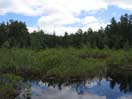
On Wednesday June 06, I (Bob) visited Ooze Lake in Eastern Algonquin Park. I started at the Brigham Lake parking lot and traveled by canoe down the Barron River to Brigham Lake and then portaged to Opalescent Lake and then again to Ooze Lake. I returned via High Falls Lake and descended the Barron River through The Cascades back to the parking lot. My goal was to search for orchids. I have had good recent success in finding Arethusa bulbosa outside of Algonquin Park and since they are rare within the Park, I thought it would be fun to find one. Ooze Lake struck me as a good candidate location. I was wrong; none were found.
Barron River
The Barron River in Algonquin Park approaching Brigham Lake -- lots of water. I passed this way on my recent trip into Ooze Lake.
My day at Ooze Lake, has now been written up as a bushlog entry.
(photo by Bob: 2007 June 06)
Campsite on Opalescent Lake
People rave about this campsite on Opalescent Lake with its "stone couch". Personally, I think it's an abomination. Oh well, different strokes for different folks.
Opalescent Lake, Algonquin Park
(photo by Bob: 2007 August 29)
f16 and be there
A cow moose and calf at Ooze Lake in Algonquin Park. The calf would be no more than a month old and probably less.
A complete description of my day at Ooze Lake, has now been written up as a bushlog entry.
(photo by Bob: 2007 June 06)
The Moose at Ooze Lake
This photo is previous to yesterday's. At this time I was unaware of the calf. This is as close as I approached and I retreated to a spot on the shore a little up the lake. The moose then started coming after me. I was no longer the stalker but rather the stalked. I retreated out into the lake. The moose and her calf then proceeded past me along the shore and we both went on our separate ways.
A complete description of my day at Ooze Lake, has now been written up as a bushlog entry.
(photo by Bob: 2007 June 06)
The Cascades
Diana contemplating the Cascades on the Barron River in Algonquin Park.
(As indicated on the map; see Where are "The Cascades"?)
(photographed: 2006 May 09)
Decay
This old log cabin sits mouldering in the bush, just off the portage trail around the Cascades on the Barron River in Algonquin Park. It probably dates back to the last log drives on the river.
I passed by The Cascades on my return from Ooze Lake, which has now been written up as a bushlog entry.
(photo by Bob: 2007 June 06)
High Falls
The natural water slide at High Falls is very popular. It is accessible by canoe from Achray via Stratton Lake, and on foot via the Eastern Pines Hiking Trail, or more easily by following a trail that starts from the Achray Road a few hundred meters west of the Brigham Lake Access parking lot.
High Falls at High Water: Water Slide
The High Falls area of the Barron River, near Achray in Algonquin Park, provides striking scenery and a natural water slide. While the water slide provides relatively safe family swimming at summer temperatures and flow rates, it has an entirely different character during the spring runoff.
Where are "The Cascades"?
Where are The Cascades? I theorize that the name "The Cascades" was originally meant to apply to the High Falls Area in Algonquin Provincial Park.
Barron River
Another picture from last Thursday's hike in to the natural water slide at High Falls near Achray in Algonquin Park. This view is of a small chute upstream of the water slide. For more photos of the water slide and High Falls at Spring water levels, see my new Bush Log entry: High Falls at High Water.
(photographed: 2006 April 27)
Water Slide
Last Thursday my cousin Alan and I walked in to the natural water slide at High Falls near Achray in Algonquin Park. Here Alan is getting a closeup of the flow at the top of the slide. For more photos of the water slide and High Falls at Spring water levels, see my new Bush Log entry: High Falls at High Water.
(photographed: 2006 April 27)
Return to High Falls
Two weeks ago I visited High Falls and posted photos on "The View" (Water Slide and Barron River) and as a "Bushlog" entry (High Falls at High Water). On Tuesday, accompanied by Diana, I returned to High Falls, this time approaching from the downstream side. While the flow has significantly decreased, the falls are still impressive.
(photographed: 2006 May 09)
Water Slide
The natural water slide at High Falls on the Barron River, near Achray, in Algonquin Park.
Early reports claim that these pools used to be teeming with eels; supposedly, they used to haul 'em out by the wagonfull. But if that is so, how did the eels negotiate High Falls?
(photographed: 2005 July 15)
Smooth
The Barron River begins its plunge over High Falls, near Achray, in Algonquin Park.
(photographed: 2005 July 15)
Violent
High Falls on the Barron River, near Achray, in Algonquin Park.
No, this is not the water slide! The water slide is a little upstream.
(photographed: 2005 July 15)
Not Alone
And while I was busy photographing from the top of High Falls ...
(photographed: 2005 July 15)
St. Andrews Lake
St. Andrews Lake is easily accessible from Achray via Stratton Lake; only two short portages are involved. St Andrews is a pretty little lake with some scenic low cliffs on the eastern shore. Along the portage from St. Andrews Lake to High Falls Lake, there is evidence of the previous logging days: A sunken pointer boat at the top; river "improvements", also near the top; and supposedly the remains of a timber slide at the bottom.
St. Andrews Lake also provides access to St. Francis Lake (via Rouge lake), Tarn lake and Marie Lake.
Basking Snakes at St. Andrew's Lake
Basking Snakes at St. Andrew's Lake in Algonquin Provincial Park.
Logging Chute
Logging Chute on St. Andrews Lake in Algonquin Park. Certainly, when the logs were being run in the spring, the water flow would have been much higher.
One may presume as well that it was easier to run the logs through St. Andrews Lake and thence down the Barron River, than to cope with the High Falls outlet of Stratton Lake.
(photo by Diana: 2007 September 19)
St. Andrews Lake
Our lunch spot on St. Andrews Lake in Algonquin Park.
An aside: The portage between Rouge Lake and St. Andrews Lake now runs along the old railway line. Even the most recent Algonquin Park Canoe Routes Map does not show it correctly.
(photo by Diana: 2007 September 18)
A Sad End
The remains of a Pointer decaying on the shores of St. Andrews Lake in Algonquin Park. The Pointer was an extremely manoeuverable flat bottomed wooden boat, sharply pointed at each end, that "could float on a heavy dew". It was the workhorse of log drives on the rivers of the Ottawa Valley and much farther afield. The standard red paint is still faintly visible on the stem.
(photo by Bob: 2007 September 19)
Chute
This little chute is between St. Andrews Lake and High Falls Lake in Algonquin Park.
(photographed: 2006 May 09)
Carcajou Bay / Carcajou Creek / Spectacle Lakes
From Achray, you can paddle straight across Grand lake and explore Carcajou Bay. There is another "High Falls" at the top of Carcajou Bay. If you portage around the falls, you can explore upstream on Carcajou Creek or alternatively check out the Spectacle Lakes.
Jack Pine on Carcajou Bay
The Jack Pine, by Tom Thomson, is one of Canada's best known paintings and that particular tree is probably the best known tree in Canadian Art. Almost certainly, that tree no longer exists. Indeed, an urban (bush?) -myth has it that it was burned as firewood in the '70s. But while the "original" jack pine is now gone, its relatives live on in the Achray area.
Trees and Granite
At the mouth of Carcajou Bay on Grand Lake in Algonquin Provincial Park
(photographed: 2005 June 01)
Carcajou Creek
A minor channel of Carcajou Creek tumbles under the cedars into Carcajou Bay. (Grand Lake, Algonquin Provincial Park.)
(photographed: 2005 June 01)
Carcajou Creek
The approach of the remnants of tropical storm Ernesto
(photo by Bob: 2006 September 01)
Marsh
Carcajou Creek above Grand Lake.
Those clouds look like they're brewing up some weather -- and they were!
(photographed: 2005 June 01)
Rock Face
Between Carcajou Creek and the Spectacle Lakes in Algonquin Provincial Park
(photographed: 2005 June 01)
Impasse
While a small creek connects the two Spectacle Lakes, it really is necessary to portage. Further progress upstream from this point is somewhat impractical.
(And the weather continues to brew.)
(photographed: 2005 June 01)
Grand Lake
Another day trip out of Achray is to paddle up to the top of Grand Lake. Once you get up to the top half of Grand Lake, you are unlikely to see anyone. No portaging on this trip but you wouldn't want to do it on a windy day.
Another Stump
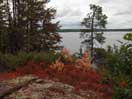
At the mouth of Rowan Creek on Grand Lake in Algonquin Park.
(photographed: 2005 August 23)
Cliff with Lichens
At the mouth of Kennedy Bay on Grand Lake in Algonquin Park.
(photographed: 2005 August 23)
Transmission Lines
On Grand Lake looking up the Barron River towards Clemow Lake in Algonquin Park.
The transmission lines in the middle distance cut a scar across Algonquin Park, providing southern Ontario with power from the Swisha Dam (des Joachims). An impenetrable mass of water lilies clogs the Barron River at this location; to proceed upstream, a one kilometer portage is necessary.
(photographed: 2005 August 23)
McManus Lake to Whitson Lake
Another interesting day trip is to start at McManus Lake and paddle upstream on the Petawawa River to the top of Whitson Lake. No portaging is required if you are prepared to wade the fast sections of the river between the lakes. Whitson lake is worth a visit because the vegetation is so different from anywhere else in the vicinity.
Resting
The paddle from McManus Lake to the bottom of Five Mile Rapids in Algonquin Park (see yesterday's post) and return is a reasonable day's expedition. But we usually do this trip a little later in the season when the flow in the Petawawa is lighter. On Friday we found the upstream paddling between Smith and Whitson Lake to be quite "challenging".
On the return trip (downstream) through this section, the gps indicated we were traveling at almost 12 km/hr. I would therefore estimate that the current was at least 5 or 6 km/hr. -- maybe more. No wonder we were tired paddling upstream.
(photographed: 2006 July 07)
Smith Lake
Smith Lake on the Petawawa River in Algonquin Park, looking upstream towards Whitson Lake.
(photographed: 2005 August 15)
Whitson Lake
Looking upstream from the bottom of Whitson Lake on the Petawawa River in Algonquin Park.
The Algonquin Park Canoe Routes Map notes that "the striking Silver Maple, common only along the Petawawa River, lends a southern flavour to this locale."
(photographed: 2005 August 15)
Whitson Lake Campsite
This campsite on Whitson lake is at the end of an old road. Obviously, the road is still used since we saw fresh ATV tracks by the shore.
(photo by Diana: 2007 July 23)
Silver Maples at Whitson Lake
The Algonquin Park Canoe Routes Map says:
"The striking Silver Maple, common only along the Petawawa River, lends a southern flavour to this locale."
I have yet to see an explanation as to why this atypical ecosystem exists here. My guess is that this is one of the few locations in Algonquin Park that are characterized by rich, regularly irrigated, alluvial deposits. (But don't ask me why Silver Maples have not invaded the Nipissing Marsh.)
(photo by Diana: 2007 July 23)
Five Mile Rapids Campsite
This pleasant little campsite overlooks the Petawawa River at the foot of Five Mile Rapids.
(photo by Diana: 2007 July 23)
Five Mile Rapids
A week ago we paddled up the Petawawa River in Algonquin Park from McManus Lake to the bottom of Five Mile Rapids. The flow in the river was remarkably high for this time of year. This location is usually just gravel bars.
Last year we exhausted ourselves paddling most of the way up the swift between Smith Lake and Whitson Lake. This year, the flow was too high to even consider doing that.
(See also Five Mile Rapids in 2005 August).
(photo by Diana: 2007 July 23)
Five Mile Rapids
Looking upstream from the bottom of Five Mile Rapids on the Petawawa River in Algonquin Park.
(photographed: 2006 July 07)
Five Mile Rapids
Five Mile Rapids on the Petawawa River in Algonquin Park.
An interesting paddling day-excursion is to start at McManus Lake and make your way upstream on the Petawawa River. This is the farthest upstream that I've managed -- about a kilometer up Five Mile Rapids -- before running out of energy, water and time.
(photographed: 2005 August 15)
Eustache Lake
You can drive in to the old train station location at Lake Travers and then follow the abandoned railbed west to the Petawawa River. From there you can pickup the portage trail into Eustache Lake.
A Hike to Eustache Lake
A Hike to Eustache Lake in Algonquin Park. Today, my friend Richard and I day-hiked into Eustache Lake in north-eastern Algonquin Park. According to the park map: "The deepest lake in Algonquin, Eustache is ringed by 25m cliffs, which continue down, through its amazingly clear waters for another 90m." We started at the former site of the Lake Traverse Railway Station -- now just a clearing beside a marsh. We walked along the abandoned railway line and then onto the Devil's Cellar Rapids portage along the Petawawa River.
Devil's Cellar Rapids
The top of Devil's Cellar Rapids on the Petawawa River. (The initial ledge is off camera to the left.)
Last Friday, Diana and I hiked into Eustache Lake in Algonquin Park. This was almost three years to the day since my last visit there; see A Walk to Eustache lake. For the next several days, we will feature photos from last Friday's hike.
(photo by Bob: 2006 October 06)
Clear Water. Green Water.
While Eustache Lake is purported to be the deepest lake in Algonquin Park at 90 m, this view shows a somewhat shallower part. But it does show the clear greenish water that is characteristic of an Algonquin headwater lake. The clarity is due to it being groundwater fed; the greenish cast is due to the groundwater's mineral content.
(photo by Diana: 2006 October 06)
Lake Bottom
Another look at the green water of Eustache Lake in Algonquin Park.
(photo by Bob: 2006 October 06)
Eustache Lake Campsite
From the second campsite on the north shore of Eustache Lake in Algonquin Park. The cliffs are lower here.
(photo by Bob: 2006 October 06)
Lunch Break
Not a good spot to snooze if you roll around in your sleep.
(photo by Diana: 2006 October 06)
Eustache Lake
While the view is spectacular from the cliffs along the north shore of Eustache Lake in Algonquin Park, it is difficult to find an unobstructed location for photography.
(photo by Bob: 2006 October 06)
The North Rim
Along the north rim of Eustache Lake in Algonquin Park. (The lake is a little to the left and about 25 m down.)
(photo by Diana: 2006 October 06)
Lake Travers
Lake Travers is easily accessible from the Achray road, although it is a long drive. It is the usual starting point for overnight trips down the Petawawa River to McManus Lake, but it is also a destination in its own right.
Bridge at Poplar Rapids
The bridge over the Petawawa River where it flows into Lake Travers in Algonquin Park.
(photo by Diana: 2007 July 16)
Behind the Island
In Lake Travers in Algonquin Park, the channel between the big island and the shore is choked with pickerel weed.
(photo by Diana: 2007 July 16)
Marshy Shoreline
The marshy shoreline of the "big island" in Lake Travers in Algonquin Park. The skyline is enhanced by significant wind damage to the interior of the island.
(photo by Diana: 2007 July 16)
Sec Lake
Sec Lake is another easy access lake off the Achray Road. It is also possible to do a loop through Wet Lake and Norm's Lake, but that is something that we've yet to do.
Wenda Lake
You can combine a hike with paddling by starting at Achray on Grand Lake, paddling part way up the lake, stashing your canoe in the bush and then hiking over the portage to Wenda Lake (returning the same way). If you're going to do this, it is probably best to enquire at the Sand Lake Gate to ensure that no one is staying at the Wenda Lake cabin. The portage leads directly to the cabin and doesn't provide much in the way of alternative destinations.
Similar paddling and hiking trips are possible into Rowan Lake and into Tarn Lake (via St. Andrews Lake). We've yet to do the former. When we were younger, we did the day trip into Tarn Lake a couple of times, but not in a long time.
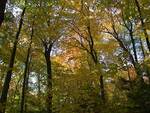
Wenda Lake Hardwoods
The Wenda Lake Hardwoods is a protected sub mature to mature tolerant deciduous forest (Beech, Sugar Maple and scattered large Yellow Birch) situated on the hill between Grand Lake and Wenda Lake in eastern Algonquin Park. It is a unique local example of a forest type more commonly found on the west side of Algonquin Park.
Along the Trail to Wenda Lake
A week ago Friday, we walked the portage into Wenda Lake in Algonquin park. (A description of this walk from a previous year my be found in Wenda lake Hardwoods.) This year's walk was pleasant but uneventful. However, about 0.5 km from Wenda Lake, we passed through an area of massive destruction, presumably the product of this summer's storm of July 17. The canoe rangers have done an impressive job in reestablishing the portage.
(photo by Diana: 2006 September 22)
Wenda Lake Portage
Another view of storm damage along the Wenda Lake Portage and its subsequent cleanup.
(photo by Diana: 2006 September 22)
Berm Lake Trail
Starting from Achray, the Berm Lake Trail provides a pleasant day hike around Berm Lake.
An Early Fall Hike Around Berm Lake and Johnston Lake
During the second week of September we hiked around Berm Lake and Johnston Lake, near Achray on the east side of Algonquin Provincial Park. The trail around Berm Lake is an interpretive walking trail, and the trail around Johnston Lake is part of the Eastern Pines Hiking Trail.
Winterberry Holly
Winterberry Holly along the Berm Lake trail in Algonquin Park. A Bush Log Entry describing our hike around Berm and Johnston Lake in Algonquin Park will appear soon.
(photo by Diana: 2006 September 12)
Berm Lake
About a week ago, we hiked around Berm Lake and Johnston Lake, near Achray on the east side of Algonquin Provincial Park. The trail around Berm Lake is an interpretive walking trail, and the trail around Johnston Lake is part of the Eastern Pines Hiking Trail. For a fuller description of our hike, see our Bush Log entry: An Early Fall Hike Around Berm Lake and Johnston Lake.
(photo by Bob: 2006 September 12)
Bibliography
Donald L. Lloyd (2000); Canoeing Algonquin Park, Published by D.L. Lloyd. Distributed by Hushion House Publishing Ltd. Toronto.
Michael W.P. Runtz (1993), The Explorer's Guide to Algonquin Park, Stoddard Publishing Co. Ltd.
Disclaimer
This section of our website comprises pages relevant to the various themes of this site where the content, or our understanding, is incomplete.
They may be:
- notes because they are often snippets of information that we have gleaned from other sources.
- thoughts because these facts are tied together with our opinions and speculation.
- drafts because they are continually under development as we learn more or collect additional material.
Use this material with caution and intelligence.